NOTE PER LA CONSULTAZIONE

NOTE PER LA CONSULTAZIONE:
Per leggere, scorrete la pagina verso il basso: il blog è come una rivista che va "srotolata" anziché sfogliarla. La grafica è ottimizzata per gli schermi dei computer; se leggete da un telefono o tablet, vi consigliamo di tenerlo in posizione "orizzontale".
Per la ricerca di artisti, temi e luoghi usate la casella Cerca nel Blog oppure l'Indice Alfabetico sul lato destro della pagina, visibile scorrendo un poco verso il basso.
Per contattarci: Rita Castigli rita.castigli@gmail.com - Aurelio Stoppini aureliostoppini@libero.it
Visualizzazione post con etichetta Il Gianicolo. Mostra tutti i post

giovedì 4 giugno 2015

La tavolozza e l'amore impossibile

Bruno Donzelli in mostra al "Gianicolo"


Bruno Donzelli


Se c'è un pittore originale, questo è Bruno Donzelli.
Si dice, da parte di moltissimi, che ormai tutto è stato tentato nel campo della pittura e non ci sono più possibilità di fare qualcosa di nuovo e originale, e questo a dispetto delle tante avanguardie che si sono rubate la scena nell'arco di tutto il XX secolo.  È anche tipico da parte dei critici d'arte di ricollegare ogni pittore a una corrente o a un'altra, a un caposcuola o a un altro e comunque individuare l'iniziatore di  una determinata tecnica, facendo a gara nel risalire la scala filogenetica il più indietro possibile. Non si discute nemmeno più la legittimità di una tendenza alla citazione, godendo della caccia ai rimandi quasi fosse una sfida tra pittori e critici.
In questo quadro culturale c'è un pittore che spunta le armi a tutti dichiarando apertamente le sue fonti d'ispirazione. Donzelli non imita nessuno né segue una corrente, Donzelli fa. Il suo percorso si svolge solo sopra alle tele dei famosi pittori del '900, ci cammina sopra con i suoi colori e i suoi pennelli, rifugiandosi nei loro stilemi e segni caratteristici. Donzelli denuncia lo stato di fine millennio e di esaurimento delle possibilità espressive. Sembra dire che ormai si può prescindere dal senso profondo esistenziale delle opere d'arte per navigare sulle loro forme. Strappa i segni dal momento storico e psicologico che li hanno generati e li ripropone come feticci culturali. Subito riconoscibili. E, a scanso di ogni dubbio, scrive grandissimo e più volte il nome del pittore cui il suo quadro si riferisce rendendo anche quelle lettere, scritte in un frettoloso stampatello, un luogo comune. 


Bruno Donzelli

La citazione è così esplicita da essere sfacciata e perfino sguaiata. Una micidiale aggressività traspare dai colori e dai segni decisi e netti, un'energia tribale guida il pennello quasi fosse un'arma durante un rito totemico. Il pittore si riconosce membro di una tribù i cui totem sono i celebri antenati. Da questi si riconosce posseduto. Ma nella stessa possessione trova il suo riscatto, la liberazione. I suoi Picasso, i suoi Dine, Burri o Fontana sono semplici icone che richiamano il passato e ne denunciano la lontananza, hanno perso l'aggancio rivoluzionario al presente, sono una galleria di ritratti di famiglia ben spolverati e lucidi.

Bruno Donzelli

Mi ha colpito un'affermazione che Bruno Donzelli ha fatto a Eligio Fulli e che cito liberamente: se non dipingessi, starei in manicomio. La necessità dell'arte per sopravvivere e per leggere il senso del vivere spiega la tremenda energia che si coglie nei quadri di Donzelli. C'è un bisogno assoluto di trovare forme sintetiche attraverso le quali interpretare il mondo e c'è l'ammissione, senza possibilità di repliche, che queste forme sono già state create e non se ne possono inventare altre. Così la palese aggressività dei suoi dipinti si può interpretare come amore, l'amore impossibile di Cervantes per i poemi cavallereschi in Don Chisciotte o la passione letteraria e suicida di Emma Bovary.
Bruno Donzelli


The Palette and the impossible Love

Bruno Donzelli's exhibition at "Il Gianicolo", Perugia

If there is an original painter, this is Bruno Donzelli.
It is usually said, by many, that everything has been tried in the field of painting and there are no more opportunities to do something new and original, and this in spite of the many avant-garde that have stolen the scene during the whole XX century. It is also typical by art critics to reconnect every painter to a current or another, to a master or another, and to identify the initiator of a particular technique, competing in tracing the phylogenetic scale as far back as possible. There is no disputing the legitimacy of the tendency to quote, enjoying the hunt for references as if it were a contest between painters and critics.
In this cultural context there is a painter who blunts their weapons, openly declaring his sources of inspiration. Donzelli does not imitate anyone or follow a current, Donzelli makes. His journey takes place only on the paintings of famous painters of the '900, walks on them with his colors and paintbrushes and finds refuge in their stylistic and characteristic signs. Donzelli complaints the end of the millennium and the exhaustion of expressive possibilities. He seems to say that now we can ignore the profound existencial sense of artworks to navigate on their forms. Ripping the signs away from the historical and psychological condition that generated them, he proposes them as cultural fetishes. Immediately recognizable. And, for the avoidance of any doubt, he writes big and repeatedly the name of the painter referred to in his work making even those words, written in hurried block letters, a commonplace.

The quote is so explicit as to be bold and even coarse. A deadly aggressiveness is reflected by the determined colors and signs, a tribal energy guides Donzelli's brush as if it were a weapon during a totemic ritual. The painter recognizes himself a member of a tribe whose totems are its famous ancestors. By these he feels possessed. But in the same possession he finds his redemption, liberation. His Picasso, his Dine, Fontana or Burri are simple icons that recall the past and denounce the distance, they have lost the revolutionary grip to the present, they form a gallery of well-dusted and polished family portraits.

I was struck by a statement that Bruno Donzelli made to Eligio Fulli and I quote freely: had I not been a painter, I would have been in a mental hospital. The necessity of art to survive and to read the meaning of life through it explains the tremendous energy that we find in the paintings of Donzelli. There is an absolute need to find synthetic forms through which to interpret the world. There is also the admission without the possibility of any reply that these forms have already been created and that no new ones can be invented. So the blatant aggression of his paintings can be explained as love, like Cervantes' impossible love for the poems of chivalry in Don Quixote, or Emma Bovary's literary passion and suicide.


Eligio Fulli

Bruno Donzelli

Bruno Donzelli


Galleria Il Gianicolo


Eligio Fulli

Bruno Donzelli
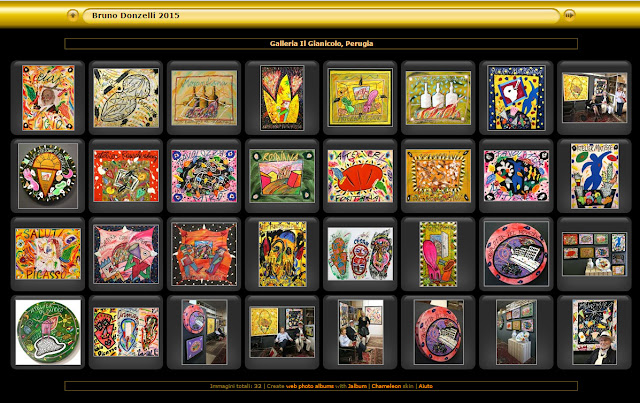
Cliccare sul mosaico per accedere all'ALBUM della mostra / Clic on the mosaic to get a photo album of the exhibition 


Collegamenti\Links :


domenica 28 dicembre 2014

L'eredità di Franz Borghese

L'eco non spenta della feroce ironia del maestro romano


Franz Borghese


Franz Borghese crea scene di teatro. Sono scene senza voci ma con parole che si possono intuire o suggerire. Mancano i dialoghi nella sceneggiatura del film di cui però i quadri di Borghese potrebbero essere le scene. Un film che un regista come Dino Risi, severo e irridente affrescatore di costumi italiani, avrebbe potuto girare. 
Basti pensare a un film a episodi come "I mostri" che, se fosse stato a colori, avrebbe avuto quelli di Borghese. Egli sarebbe stato anche il direttore della fotografia con un taglio che include tutti gli elementi significativi e solo quelli. Infatti i paesaggi mancano e lo spazio è lo spazio delle relazioni umane, immateriale perché concretamente fatto dei rapporti sociali e psicologici che Borghese coglie e rappresenta come un antropologo con grande capacità di sintesi. Sarebbe stato anche costumista scegliendo abiti di taglio severo e colore scuro che darebbero un'idea di serietà se non stessero invece ad evidenziare l'immoralità dietro l'ipocrita paludamento. L'impressione di virile rettitudine fa risaltare la stolida cattiveria.

Eligio Fulli conosceva bene il pittore e ne organizzò numerose mostre sempre documentate con ricchi e significativi cataloghi e libri editi da Il Gianicolo. 
Ci ha raccontato episodi divertenti e anche la rispostaccia che l'Artista diede al PCI che lo voleva sponsorizzare per utilizzarlo come propaganda. Nei suoi lavori, Borghese non attaccava un partito o corrente politica, ma le debolezze che l'uomo ha sempre cercato di camuffare anziché reprimere o correggere.

Franz Borghese creates theatre scenes. Scenes without voices but with words you can guess or suggest. There aren't any dialogues, but the large plot of a film of which Borghese's paintings may be the scenes. A film that Dino Risi, stern and mocking Italian painter of manners, could love to shoot. 
Just think of an episodic film like "The Monsters":  if it wasn't a black-and-white film, it would be in Borghese's colours. His would be the direction of photography and of settings. In fact,  landscapes are missing, space is the space of human relations, an immaterial space  made of social and psychological elements which Borghese captures and represents as an anthropologist with great capacity for synthesis. He would have been even costume designer choosing severe style and dark color clothes giving an idea of seriousness while highlighting the immorality hidden in hypocritical attires. The impression of manly uprightness brings out the stolid nastiness.

Eligio Fulli used to be acquainted with the painter and organized numerous exhibitions always documented with rich and significant catalogs and books published by Il Gianicolo. 
He has told us funny episodes and also the answer that the artist gave to PCI when they wanted to sponsor and use his works as propaganda. But he did not attack specifically a political party or movement, his targets were the weaknesses that man always tries to camouflage rather than repress or correct.


Franz Borghese

Franz Borghese

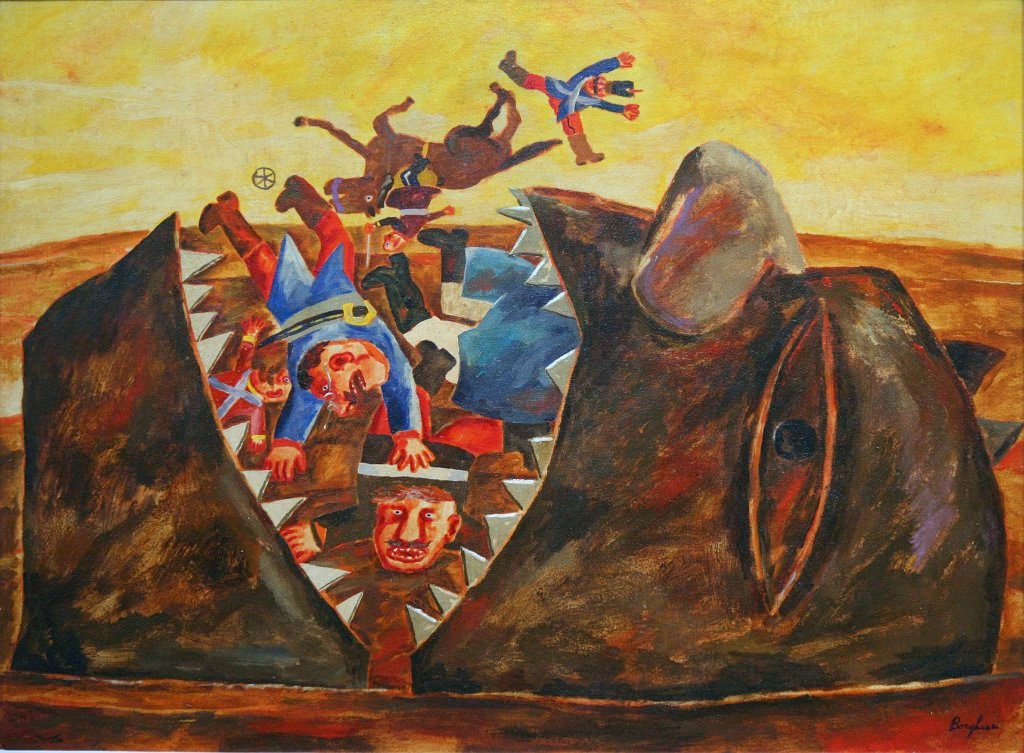
I colori sono densi e decisi con il rosso a dominare come il fuoco della Geenna, come nell'inferno. Ma Borghese rappresenta l'al-di-qua, dove la miseria spirituale non fa soffrire in un mondo maschile e maschilista e dove manca la grazia comunque la si intenda. Così anche le figure sono tozze, pesanti, massicce e indossano il cilindro benché non fosse più in voga da decenni, ma è l'unico elemento che, come una corona o un'aureola, solleva e nobilita grottescamente le figure. Sembra un cappello che pesa come un macigno coi simboli di vanità e potere che contiene, e mi ricorda la feroce descrizione che Jonathan Swift fece dei membri di una setta che indossavano sempre un copricapo con risultati devastanti per il cervello.

Ironico e pensoso, è scomparso improvvisamente nel 2005, ma ha lasciato una copiosa eredità di opere ispirate e intense. A distanza di tempo, oramai asciugatasi pure la risacca di quell'onda mordace che produsse i geniali spettacoli di Giorgio Gaber e Dario Fo, i suoi quadri conservano la bellezza di una grande coerenza stilistica e colori luciferini, mentre i disegni ritraggono riflessi di pensieri lucidi e definitivi come aforismi.

The colors are dense and red dominates above the others creating the impression of a hellish circle. But Borghese doesn't represent afterlife, he represent life, where the spiritual poverty doesn't hurt in a world where men lack grace in any sense. The figures are squat, heavy, massive and wear top hats although they hadn't been in vogue for decades. Those are the only element that, like crowns or halos, raise and ennoble the grotesque figures. They weigh a ton, it seems, carrying symbols of vanity and power, and they remind me the merciless description that Jonathan Swift made of the members of a sect who always wore a hat with devastating results for the brain.

Ironic and thoughtful, he suddenly passed away in 2005, but he left an abundant legacy of inspired and intense works. The times that also produced the brilliant performances of Giorgio Gaber and Dario Fo have gone by, but his paintings preserve the beauty of a great stylistic consistency and diabolic colours, while his drawings portray reflections of thoughts which are as shiny and definitive as aphorisms.


Franz Borghese

Franz Borghese

Le sculture condensano nelle loro masse brune di bronzo meditazioni sul senso della condizione umana, sulla pesantezza e l'opacità dell'essere sulla terra senza riscatto e senza un futuro luminoso. 
Per questo le goffe figure, sotto quei cilindri magniloquenti, suscitano un sentimento di simpatia, perché inducono alla consapevolezza della nostra stessa debolezza nascosta. Esse non sono solo gli Altri, i Cattivi, i Mostri, ma sono anche gli Everyman, i Chiunque, nascosti in un abito di bronzo come in una corazza di false certezze e simulata potenza.
In their brown bronze masses, Borghese's sculptures condense meditations on the meaning of human condition, the heaviness and opacity of being on earth without redemption and without a bright future. 
Because of that, the clumsy figures, under their grandiloquent top hats, arouse a feeling of sympathy, leading to an awareness of our own hidden weakness. They are the Others, the Bad, the Monsters, but they are also Everyman, hiding false certainties and simulated power in a bronze armour.


Franz Borghese


Franz Borghese

Franz Borghese

Franz Borghese

Franz Borghese

Franz Borghese


Eligio e Vittoria Fulli hanno recentemente esposto una magnifica scelta di opere di questo artista a loro così caro, rivelando la sua attualità e la pertinenza del suo messaggio ancora incisivo e riconoscibile oggi con la sua eco di risata e di pianto.


Eligio and Vittoria Fulli have recently exhibited a magnificent selection of works by this artist who was and is so dear to them, revealing how timeliness and relevant his message is and still incisive and recognizable today with its echo of laughter and tears.

Franz Borghese
Autoritratto di Franz Borghese (collezione Eligio Fulli)
Franz Borghese

Il GianicoloRita Castigli

Eligio e Vittoria Fulli, Rita Castigli


Collegamenti\Links :


mercoledì 12 febbraio 2014

Teatro d'arte e di pensiero

Il Gianicolo a Perugia


L'Italia è depositaria di un'immensa quantità di opere d'arte distribuite tra chiese musei e collezioni private. 
Un assetto che tende ad essere piuttosto statico e definitivo, animato però spesso da esposizioni temporanee che offrono nuovi approcci ed approfondimenti. 
Ma la passione trova i suoi canali d'espressione più accesi nelle “botteghe” e nei mercati, centri gravitazionali di cultura storica e tecnologica e acribia nella bellezza e stile. Qui ci sono i viventi, i contemporanei ancora a caccia di una collocazione e di una definizione che li posizioni nei musei a venire. 
Italy is the repository of a vast amount of artwork distributed among churches, museums and private collections. 
An arrangement that tends to be rather static and definitive but which is often animated by temporary exhibitions that offer new approaches and insights. 
But passion for art finds its most intense channels of expression in "workshops" and in the markets, gravitational fields of historical culture and technological innovation. Here are the living contemporaries still hunting for a place and a definition that sets them in museums to come.


Il passaggio obbligato è attraverso gallerie come quella di Eligio e Vittoria in cui la professionalità è una combinazione di gioco e consapevole amore. 
Nei manufatti artistici esposti si sedimentano sapori di feste e voci, racconti, musica improvvisata  e ricordi accennati, risate generose e lacrime nascoste. 
La galleria Il Gianicolo è dove avviene questo passaggio, ché l'opera d'arte contemporanea ci mette tempo a diventare solo tela o solo scultura ...  
Per il momento ci sono persone che impediscono alle cose di essere solo cose.
The transition happens through art galleries like that of Eligio and Victoria where professionalism is a combination of game and conscious love. 
In the exhibited artifacts flavors of parties and voices gather together with stories, improvised music and memories, generous laughter and hidden tears. 
The gallery Il Gianicolo is where the transition takes place, because contemporary art takes time to become just canvases or sculptures ... 
For the moment, there are people who prevent things to be just things.


Qui è dove l'inesprimibile trova accoglienza e rispetto. Il gusto di Eligio è la legge, ma chi viene qui  conosce le regole del gioco e lascia i pregiudizi fuori.
Il maestro di cerimonie crea uno spazio magico dove si parlano lingue diverse che ogni artista costruisce per dare voce al suo mondo. Da qui sono passati i più grandi.
Quando stava a Reggio Calabria la sua galleria Bruzia era un centro dove il fermento creativo degli anni '60 e '70 trovava espressione, riconoscimento e catalizzazione.
This is where the inexpressible is welcomed and respected. Eligio's taste is the law, but the people who come here know the rules of the game and leave their biases out. 
The master of ceremonies creates a magical space where different languages ​​are spoken and every artist builds his own to give voice to his world. All the greatest were his guests. 
When his gallery was in Reggio Calabria, it was a centre where the creative exuberance of the '60s and '70s found its expression and catalysation.


Poi a Perugia Eligio, con il suo bell'accento inconfondibile e la battuta pronta, ha portato con sé il respiro della capitale. 
In 35 anni di attività ha offerto il suo spazio ad artisti famosi ma anche artisti emergenti, che poi magari sono tornati a distanza di vent'anni con un nome consolidato. Come Alexander Jakhnagiev, per esempio ...

With his unmistakable nice accent and ready wit, Eligio took the breath of the capital city to Perugia. 
In 35 years of business he has offered his space to famous artists and new emerging artists who then maybe have returned after twenty years with an established name. Like Alexander Jakhnagiev, for example ...


Qui di casa sono Borghese e Vangelli, Villalta e Donzelli, Attardi e Canevari ... 
Per loro e molti altri, ha creato libri importanti che offrono chiavi di lettura e basi di decollo per la comprensione. Le mostre sono state sempre arricchite da cataloghi curatissimi e da conservare.
Here artists like Borghese and Vangelli, Villalta and Donzelli, Attardi and Canevari, are at home ...
For them and many others, Eligio has created books which are important keys to the understanding of their works. Every exhibition has been enriched by wonderful catalogues, precious to collect.


Eligio parla dei “suoi” artisti con entusiasmo e vi legge le verità inesprimibili del vivere e del morire che lui riconosce senza paura o pudore. Nella sua bella casa le cui pareti sono coperte dai quadri che ama, raccoglie gli amici a cena felici di esserci in un clima dove le conversazioni sono condizionate dall'autenticità delle opere che ne formano lo scenario. 

Così, anche se la galleria Il Gianicolo a Borgo XX Giugno non c'è più, non so ancora parlarne al passato... 
Eligio speaks of "his" artists with enthusiasm and reads inexpressible truths of life and death that he recognizes without fear or shame. In his beautiful house whose walls are covered with the paintings he loves, the friends invited for dinner are happy to be in an atmosphere where conversations are conditioned by the authenticity of the works that make up the scenario.

Thus, even if the gallery Il Gianicolo in Borgo XX Giugno is not there anymore, I'm unable to talk about it in the past tense...


Franz Borghese

Antonio Vangelli

Rita Albertini

Antonio Vangelli

Mariano Villalta

Foto: Paolo Ficola

Antonio Vangelli

Antonio Vangelli

Franz Borghese

Franz Borghese

Bruno Donzelli

Bruno Donzelli

Cristiano Carotti

________________________________________________________

Collegamenti:

Sito web della Galleria Il Gianicolo


Nota: le ultime 8 foto dell'articolo sono di Paolo Ficola; quelle di opere sono state tratte dal sito web della Galleria Il Gianicolo con il consenso della Galleria stessa.
Le foto precedenti sono "libere interpretazioni" di opere scattate da Aurelio Stoppini nel corso di alcune mostre ed eventi organizzati da Il Gianicolo.