NOTE PER LA CONSULTAZIONE

NOTE PER LA CONSULTAZIONE:
Per leggere, scorrete la pagina verso il basso: il blog è come una rivista che va "srotolata" anziché sfogliarla. La grafica è ottimizzata per gli schermi dei computer; se leggete da un telefono o tablet, vi consigliamo di tenerlo in posizione "orizzontale".
Per la ricerca di artisti, temi e luoghi usate la casella Cerca nel Blog oppure l'Indice Alfabetico sul lato destro della pagina, visibile scorrendo un poco verso il basso.
Per contattarci: Rita Castigli rita.castigli@gmail.com - Aurelio Stoppini aureliostoppini@libero.it
Visualizzazione post con etichetta Pittura contemporanea. Mostra tutti i post

martedì 3 marzo 2020

Libertà e Destino

Opere recenti di Arnhild Kart

Arnhild Kart

Arnhild Kart è cresciuta a Düsseldorf, metropoli industriale sul Reno, i cui grattacieli hanno ispirato atmosfere e valori ritmici dei suoi lavori. La metropoli inumana e impersonale, assurta  da un secolo a metafora della condizione esistenziale, è stata protagonista di bellissime tele di Arnhild, con luci e baluginii che fanno pensare alle piogge metafisiche dell'inferno dantesco o alle città del più tetro futuro fantascientifico come in Blade Runner. E sono quadri di struggente bellezza nella loro drammaticità, come pure commoventi sono i personaggi che lei costruisce, fragili saltimbanchi isolati che si arrampicano verso un cielo troppo lontano, oltre i grattacieli.

Arnhild Kart

Arnhild Kart

Artista di grande rigore formale e tecnico (infatti per molti anni è stata titolare di una fabbrica di articoli di design creando oggetti d'arredo perfetti), ha dipinto prospettive rigorose e geometrie direi pierfrancescane, un paesaggio urbano razionale ma non equilibrato né sereno. 
Col tempo quei muri e strade si sono andati scarnificando. Chi va nella cappella di San Severo a Napoli e, dopo essersi estasiato per le meravigliose sculture di marmo bianco, scende nel sotterraneo, vede quello che è la struttura vascolare indurita di un essere umano che solo ad essa è ridotto. Similmente, nei recenti quadri di Arnhild, i grattacieli sono diventati scheletri luminosi, fatti di filamenti di led che si incrociano ortogonalmente. Avvertiamo il senso metafisico di quelle strutture che sono entrate in noi come strutture di pensiero, articolazioni del senso dell'esistere. 
Ci giunge così il messaggio di Arnhild come un canto di libertà, un richiamo alla ricerca del senso al di là degli schemi imposti.

Arnhild Kart

Continuando la sua ricerca che scava le radici del vivere nelle forme che il pensiero assume, Arnhild ha individuato nel DNA il simbolo in cui sintetizzare i processi che regolano e trasformano la realtà. Nelle nuove tele si percepisce qualcosa che sembra crescere, fluire autonomamente, filamenti che sembrano essere vivi e riprodursi. La fantasia e il pennello di Arnhild inseguono con timore ed emozione  quei percorsi, lungo canali misteriosi nei quali il pensiero e la realtà cercano di incontrarsi.

Nei due quadrati neri tutta la tela è coperta da filamenti che non lasciano spazi vuoti né possibilità di dialettica. Il plexiglass dipinto dall'interno crea l'illusione dello spazio in cui scorrono le linee.
Nelle altre due tele quadrate invece restano aree che sembrano però precariamente libere con i filamenti neri che si allargano implacabili nelle aree grigie.


Arnhild Kart e Rita Castigli

Le tele rettangolari bianche e nere sembrano percorse da segni accesi e intensi con richiami a doppie spirali che hanno un ritmo musicale, una struttura melodica a più voci che si intrecciano in un campo vuoto. Un senso di bellezza e di respiro ampio ne emana, una possibilità di libertà. Note di diverse altezze e durate, timbri gravi scuri o alti e chiari. Gialli e rossi accesi e neri profondi, i colori riscaldano di emozioni leggerezze tenui e asprezze tetre, rendendo alla vita le sue tante varianti, i sapori e i moti del cuore. I segni colorati si muovono come in canali il cui illusorio spessore è ottenuto anche qui dipingendo la striscia di plexiglass dal lato posteriore.

Arnhild Kart

Nelle altre tele rettangolari lo sviluppo tortuoso dei colori di diverse tinte evoca lo spazio dinamico sia del mondo interiore umano che dell'universo, evidenziati nella parte centrale del dipinto. Negli altri settori della tela si coglie, come fuori fuoco, la stessa struttura di intrecci, il passato o il futuro di una storia in corso di svolgimento della quale l'uomo non siamo certi che sia attore responsabile con i suoi desideri ed emozioni a guidarlo o se subisca, come il resto dell'universo, un destino fatto di leggi che non dipendono da lui.

Arnhild Kart

Arnhild Kart

 Arnhild Kart

Arnhild Kart

Arnhild Kart

Arnhild Kart

Valeria Guarducci


Valeria Guarducci, Arnhild Kart e Rita Castigli


 *   *   *
Freedom and Destiny

Recent works by Arnhild Kart


Arnhild Kart grew up in
Düsseldorf, an industrial metropolis on the Rhine, whose skyscrapers inspired the atmosphere and rhythmic values ​​of Arnhild's works. The inhuman and impersonal metropolis, risen for a century as a metaphor for the existential condition, has been the protagonist of beautiful paintings by Arnhild, with lights and glimmers that suggest the metaphysical rains of Dante's hell or the cities of the darkest future science fiction like in Blade Runner. And they are paintings of poignant beauty in their drama, as well as moving are the characters she builds, fragile isolated acrobats who climb to a sky too far beyond the skyscrapers.
Artist of great formal and technical rigor (in fact for many years she was the owner of a factory of design items creating perfect furnishings), she painted rigorous perspectives and geometries I would say pierfrancescane, a rational but unbalanced and unsettled urban landscape.


Over time, those walls and streets have been somehow defleshed. Whoever goes to the chapel of San Severo in Napoli and, after having become enraptured by the wonderful white marble sculptures, goes down to the basement, sees what is the hardened vascular structure of a human being who is only reduced to it. Similarly, in Arnhild's recent paintings, skyscrapers have become luminous skeletons, made of filaments of LEDs that cross orthogonally. We feel the metaphysical sense of those structures that have entered us as structures of thought, articulations of the sense of existence. Thus Arnhild's message reaches us as a song of freedom, a call to the search for meaning beyond the imposed patterns.

Continuing her research that digs the roots of living in the forms that thought takes, Arnhild has identified in the DNA the symbol in which to synthesize the processes that regulate and transform reality. In the new canvases we perceive something that seems to grow, flow autonomously, strands that seem to be alive and reproduce.
Arnhild's fantasy and brush pursue those paths with concern and emotion, along mysterious channels in which thought and reality try to meet.
The whole black square canvases are covered with filaments that leave no empty spaces or the possibility of dialectics. The plexiglass painted from the inside creates the illusion of a space in which the lines flow.
In the other two square canvases, however, areas remain that seem precariously free while the black filaments that invade relentlessly the gray areas.


The rectangular black and white canvases seem crossed by bright and intense signs with references to double spirals that have a musical rhythm, a melodic structure with several voices that intertwine in an empty field. A sense of beauty and wide breathing emanates from it, a possibility of freedom. Notes of different heights and durations, serious dark or high light tones. Bright yellows and reds and deep blacks, the colours warm up the patterns with emotions that have soft lightness and gloomy harshness, giving life its many variations, the flavors and motions of the heart. The coloured signs move as in channels whose illusory thickness is also obtained here by painting the plexiglass strip from the rear.
 

In the other rectangular canvases the tortuous development of the colours of different hues evokes the dynamic space of both the human inner world and the universe, highlighted in the central part of the painting. In the other areas of the canvas one catches the same weaving structure, as out of focus, the past or the future of a story in progress of which man is not sure if he is responsible actor with his desires and emotions to guide him or if, like the rest of the universe, he undergoes a fate made of laws that do not depend on him.

domenica 3 novembre 2019

Mare Nostrum

Silvano D'Orsi e la metafisica del naufragio

Mare Nostrum


Le recenti tragedie dei barconi hanno toccato il cuore di Silvano D'Orsi e lui si è calato in fondo al mare per seguire la discesa lenta e morbida dei corpi verso il fondo, la loro danza senza gioia e senza speranza.
Vi è un mistero nella creazione artistica di D'Orsi dove la rappresentazione sulla tela di fatti reali si proietta in uno spazio metafisico, si espande al di fuori dell'attualità e va ad incastonarsi nella storia.
Le tante morti di migranti che si sono avventurati su fragili imbarcazioni in cerca di una vita migliore attraversando il braccio di mare che divide l'Africa dall'Europa hanno guidato il pennello di Silvano in linee sorprendenti e drammatiche che inseguono verso il buio dei fondali marini i loro corpi in discesa libera. Qui non vi sono braccia che si tendono in aiuto e mani che si stringono, mentre la luce in alto è sempre più lontana, bianca e perduta. Nella profondità di questo spaccato di mare i corpi diventano pesci abissali, luminescenti e misteriosi, trasparenti come meduse.
Ma il vero mare è anche una scenografia meravigliosa pullulante di vita colorata e spettacolare... Qui invece diventa il fondale di un dramma in bianco e nero, pieno di corpi disordinati, invaso dall'uomo, un tema, quello della distruzione della natura, da sempre sottinteso nelle tele di D'Orsi.
Il grande quadro richiama i Giudizi Universali degli affreschi italiani del Cinquecento con personaggi che fluttuano nell'aria densa inesorabilmente spinti verso il destino finale. Ma in Mare Nostrum vi sono elementi che ci portano altrove. La grazia sorprendente dei merletti disegnati sulle membra crea dubbi sull'identità dei naufraghi e ci sospinge verso altre riflessioni, altri spazi. La bellezza del segno di D'Orsi ci distoglie dal tema e restiamo intrigati nella malia della tela.
Attraverso l'arte di Silvano, la tragedia dei migranti esce dall'oggi e raccoglie echi dei mille e mille naufragi lontani, il mare diventa oceano fino a diventare l'oceano mitologico che avvolgeva il mondo e ne decideva i limiti. Qui decide il limite della vita e si allarga ad essere il simbolo di una dimensione arcana, la discesa agli inferi.
Ma sono ancora i manichini di D'Orsi a recitare la parte degli umani, sono manichini quelli che affondano, non persone. Siamo di fronte ad una recita elegante e, come a teatro, nulla è reale, ma proprio per questo quelle figure possono rappresentare ognuno, ogni perdita è di tutti, ogni morte è la Morte stessa.
E tu non chiedere per chi suona la campana. E tu non chiedere chi erano quelli che vedi su questa tela perché in questo mare dipinto, metafisica dell'esistenza, si consumano il limite della vita umana e la sua effimera e luminosa bellezza.


Gioia Sannitica

Silvano D'Orsi

L'artista, nativo di Gioia Sannitica (CE), ha donato al suo paese questa grande tela (3 x 2 metri), che è stata permanentemente installata nella sala consiliare del Municipio, dove si trovano altre importanti opere di D'Orsi visibili nelle foto che seguono. 
L'inaugurazione si è tenuta il 12 ottobre 2019 alla presenza del Sindaco Giuseppe Gaetano e di numerose autorità locali e nazionali.
 
Silvano D'Orsi
La Senatrice Sandra Lonardo taglia il nastro
Silvano D'Orsi
Il Sindaco Giuseppe Gaetano tra la Sen. Lonardo e l'artista
Silvano D'Orsi
Rita Castigli presenta l'opera
 Silvano D'Orsi

Silvano D'Orsi

Silvano D'Orsi
Veduta d'insieme della sala consiliare
Gioia Sannitica
Il Buon Governo (2018)

Silvano D'Orsi and the metaphysics of shipwrecks

The recent tragedies of the barges touched Silvano D'Orsi's heart and he lowered himself to the depth of the sea to follow the slow and soft descent of the bodies towards the bottom, their dance without joy and without hope.
There is a mystery in the artistic creation of D'Orsi where the representation of real facts on canvasses is projected into a metaphysical space, expands out of current events and goes to embed itself in history.
The many deaths of migrants who have ventured on fragile boats in search of a better life crossing the stripe of sea that divides Africa from Europe have guided Silvano's brush into surprising and dramatic lines that chase towards the darkness of the seabed their bodies downhill. Here there are no arms that tend to help and hands that tighten, while the light at the top is more and more distant, white and lost, and the bodies become abyssal fish, luminescent and mysterious, transparent like jellyfish.
But the real sea is usually a wonderful setting teeming with colorful and spectacular life ... Here instead it becomes the backdrop for a drama in black and white, full of disordered bodies, invaded by man, a theme, that of the destruction of nature, always implied in D'Orsi's paintings.
The large painting recalls the Universal Judgments of the sixteenth-century Italian frescoes with characters floating in the dense air inexorably pushed towards their final destiny. But in Mare Nostrum there are other elements that take us elsewhere. The surprising grace of lace designed on the limbs creates doubts about the identity of the shipwrecked and pushes us towards other reflections, other spaces. The beauty of D'Orsi's sign distracts us from the theme and we remain intrigued in the charm of the canvas.
Through Silvano's art, the tragedy of migrants gets out of today and collects echoes of the thousands and thousands of shipwrecks of the past, the sea becomes the ocean and finally becomes the mythological Ocean that enveloped the world and decided its limits. Here it decides the limit of life and expands to be the symbol of an arcane dimension, the descent into the underworld.
But it is still D'Orsi's mannequins to play the part of humans, those that sink are mannequins, not people. We are facing an elegant performance and, as in theater, nothing is real, but, precisely for this reason, those figures can represent everyone, every loss belongs to everyone, every death is Death itself.
And never send to know for whom the bell tolls. And never send to know who were the ones you see on this canvas because in this painted, metaphysical sea of ​​existence, the limit of human life and its ephemeral and luminous beauty are consumed.

Gioia Sannitica

Silvano D'Orsi

Silvano D'Orsi

Silvano D'Orsi

Silvano D'Orsi

Gioia Sannitica

martedì 8 gennaio 2019

Il fiume carsico e la meraviglia

Maria Stefania Fuso e la sua ricerca pittorica

Maria Stefania Fuso
 
La scuola, la laurea in architettura, il lavoro. Questa la strada voluta e percorsa con grande dedizione e affetto. Ma ce n'era un'altra che, come un fiume carsico, scorreva dentro di lei. Poi arrivò la libertà, il tempo per disporre di sé e finalmente percorrere quelle gallerie scavate dal fiume sotterraneo. E' stato un viaggio pieno di sorprese e meraviglie quello percorso da Stefania in questi suoi anni recenti, un viaggio fatto su una barca di colori con i pennelli come remi o le matite come maschera e pinne.
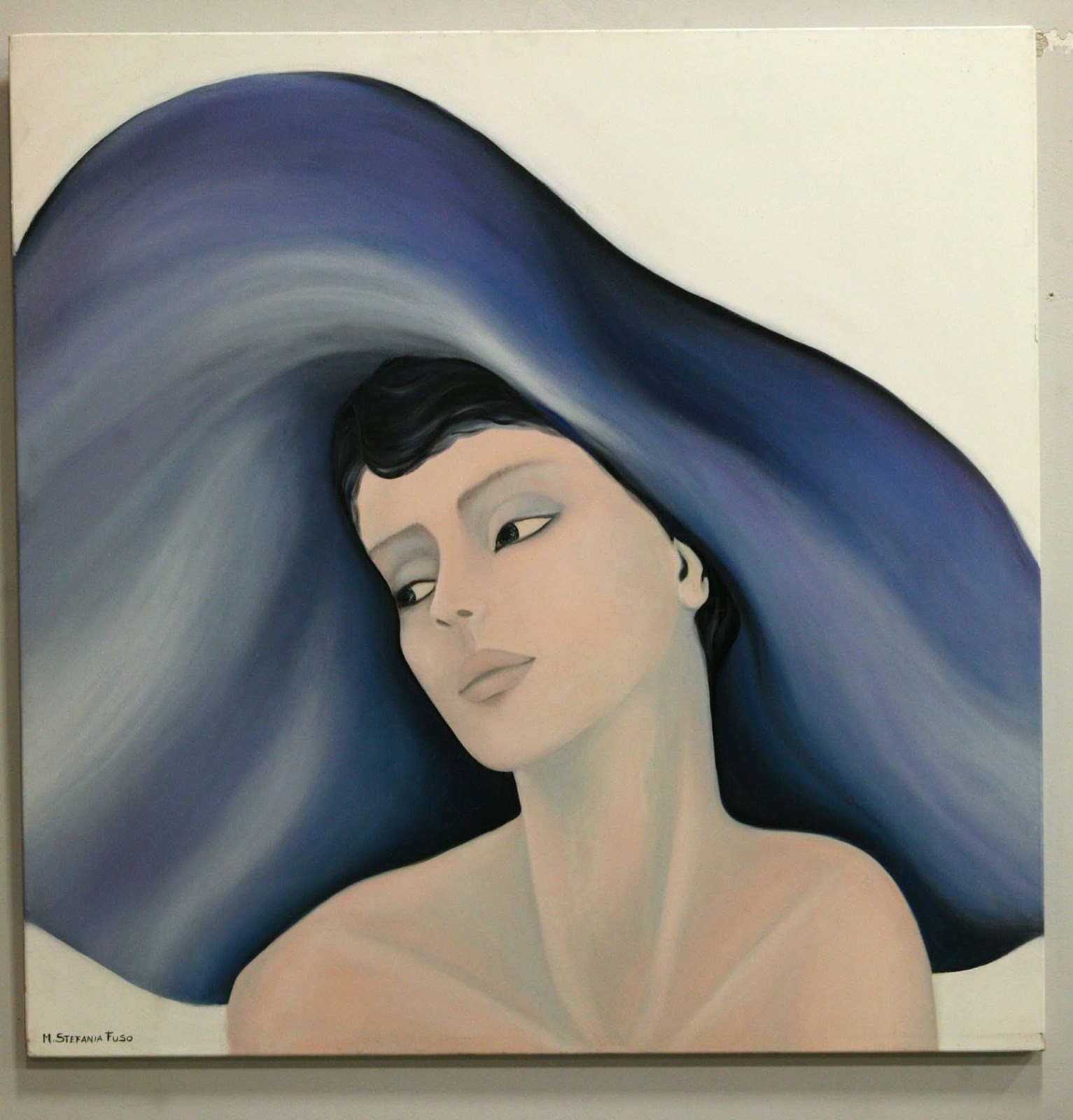
I primi quadri esposti anni or sono a Palazzo Trinci avevano infatti la trasparenza dell'acqua e tinte lacustri. Vi erano immagini di donne che si affacciavano sorprese alla vita, con occhi stupiti davanti a misteri ancora da conoscere e da svelare. Donne che, nella successiva mostra di Spoleto, avevano una nuova sicurezza e fascino. (Qui se ne possono vedere alcune.) Grandi cappelli fanno da corona ai loro visi, la sfera della loro coscienza si espande in quelle ampie aree luminose come in questo "Vestita di cielo". Richiamano le aureole dei quadri del '400, preziose e d'oro che significavano la luce divina. Queste hanno una luce umana ma che raccoglie il volo delle rondini e dei gabbiani in spazi sempre più alti.

Maria Stefania Fuso


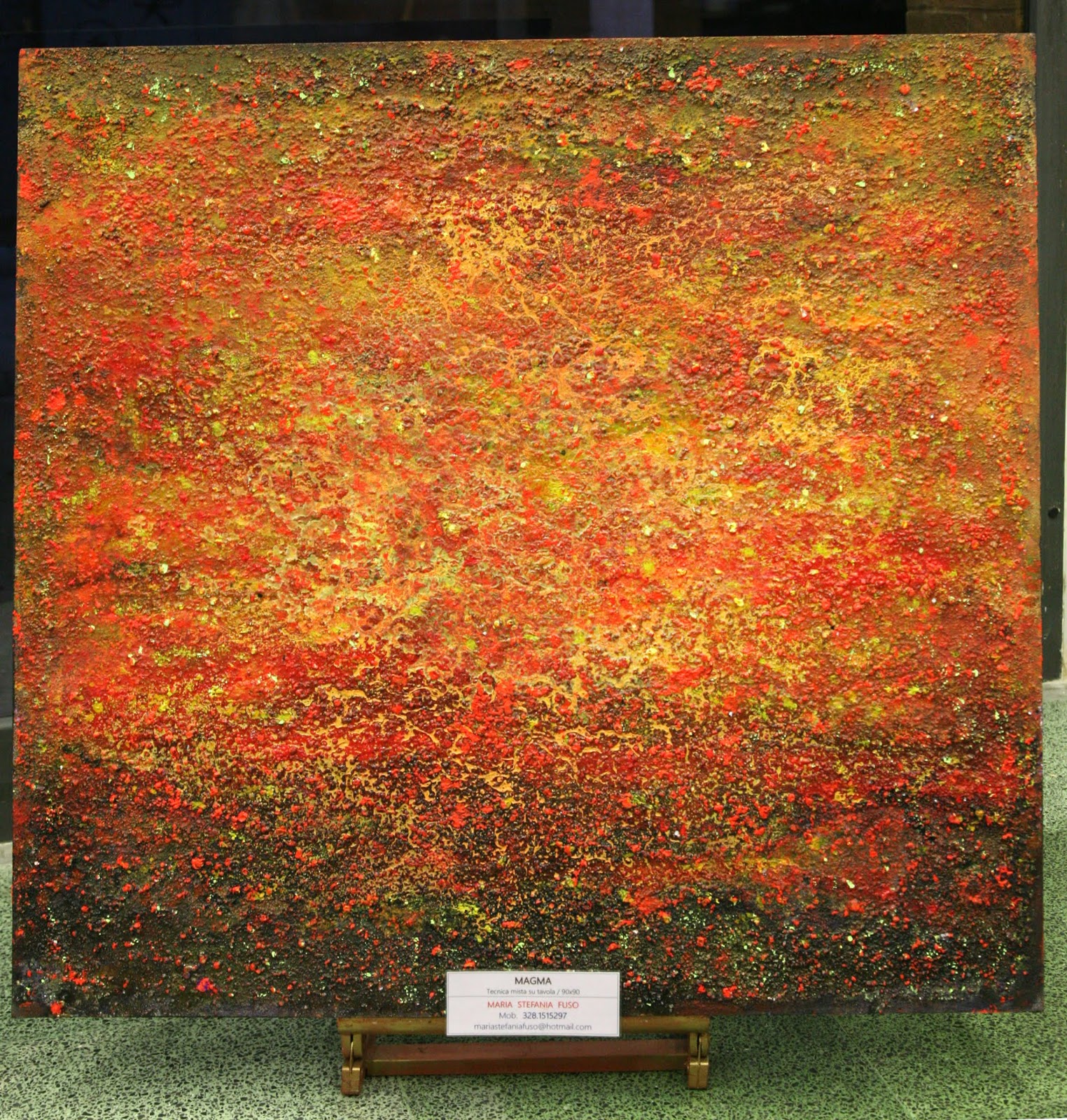
Ma poi Stefania ha ripreso il viaggio nelle grotte dell'anima, perché più in basso e in profondità voleva cercare le radici dell'esistere e del sentire. Il prima. Il punto più antico e profondo cui poter arrivare per esprimerlo.Qui le parole si sgretolano in suoni non più articolati, quelli di emozioni inesprimibili se non con colori e spesso con materiali come sabbia e più lontani dall'accademia e dai libri. Un quadro ha per titolo "Big bang" dove sembra proprio che materia si espanda senza ordine, e i due quadri "Magma" danno il senso di un ribollire di materia incandescente.

Maria Stefania Fuso


Nel suo "viaggio al centro della terra" la pittrice è giunta alla camera magmatica e oltre non si può andare, ma Stefania ha voluto contemplarne l'informe dinamismo e viverlo immergendovisi fino al limite della resistenza. Ché la pittura per lei è un'avventura febbrile gioiosa e dolorosa insieme, ma irrinunciabile. Una passione accettata, come l'etimologia implica, subita e vissuta come ineluttabile. E il suo cammino ha preso altre strade ma sempre verso i limiti dell'esperienza. "D'amore e d'azzurro" come pure "Tsunami" e "Mai fermare il vento" tornano nell'aria a respirare le tempeste dell'alta atmosfera dove "nullo homo vivente pò scappare".

Maria Stefania Fuso

Maria Stefania Fuso

Ma vi sono anche momenti di alta contemplazione come "Volino gli uccelli sopra le acque" e "Via Lattea" dove una pace pacata fa sgorgare colori dolci alla vista e l'eternità dell'oro a chiudere l'orizzonte umano con la percezione del divino. "Le sorgenti" e "Il cantico della natura" hanno la stessa atmosfera serena di appagante contemplazione. Il verde freschissimo investito dal sole primaverile che ne accende traparenze d'incanto. Poi però "L'attrazione del tempo" è un'elegia delicata dove il velo della nostalgia appanna l'indefinibile colore del rame vecchio e lo sfrangia senza scampo.

Maria Stefania Fuso
Maria Stefania Fuso
 
Ma ruit hora, l'urgenza della ricerca del senso si somma alla sempre sconvolgente percezione della finitezza della vita e quadri come "Mai fermare il vento" e "Senza argini" sconvolgono la superficie della tela con fughe di colori e linee e spessori stravolti che non hanno inizio e fine, ma entrano correndo e correndo escono dallo spazio definito del quadro. Così pure è drammatico "L'attesa della pace" dove la disturbante strisciata di rosso nella fuga degli eventi parla di sangue e violenza.

Maria Stefania Fuso
Maria Stefania Fuso
  
Scelgo "E poi l'azzurro" per concludere il mio viaggio nella ricerca pittorica di Stefania Fuso perché qui, negli spessori densi e bui sovrapposti l'uno all'altro, si scoprono spazi preziosissimi di un blu oltremare che pone un obiettivo felice in fondo a questa tempestosa avventura. Un colore che, come l'oro, veniva pagato a parte ai pittori di soggetti sacri dove però non poteva mai mancare, perché parla al cuore di futuro e di spazi spirituali e di riscatto da condizioni di buio e sofferenza. Di gioia pura.

Maria Stefania Fuso


Presentazione della mostra all'ex Teatro Piermarini, Foligno, novembre 2018  
(video di Alessandro Mastrini)

*   *   *

The Underground River and the Wonder
 
Maria Stefania Fuso and her pictorial research


The school, the degree in architecture, the work. This is the road desired and travelled with great dedication and affection. But there was another that, like an underground river, flowed inside her. Then came freedom, time to dispose of herself and finally travel those tunnels dug by the underground river. It has been a journey full of surprises and wonders that Stefania travelled in these recent years, a journey made on a boat of colours with brushes as oars and pencils as a mask and fins.
The first paintings exhibited years ago at Palazzo Trinci had in fact the transparency of water and lake colours. There were images of women who were surprised at life, with eyes astonished before mysteries yet to be known and unveiled. Women who, in the subsequent exhibition in Spoleto, had a new security and charm. (Here you can see some.) Large hats are the crown of their faces, the sphere of their consciousness expands in those large areas of light like this "
Dressed in Heaven". They recall the haloes of the 15th century paintings, precious and golden which meant divine light. These have a human light which collects the flight of swallows and seagulls in ever higher spaces.

But then Stefania resumed her journey in the caves of the soul, because deeper and deeper she wanted to look for the roots of existence and of feeling. The most ancient and profound point where you can arrive to express it. Here words crumble into sounds no longer articulated, those of emotions inexpressible if not by colours and often with materials like sand and others more distant from the academy and books. A painting has the title "
Big Bang" where it seems that matter expands without order, and the two paintings "Magma" give the sense of the bubbling of incandescent matter.

In her "
Journey to the Center of the Earth" the painter has reached the magma chamber and beyond itshe can not go, but Stefania wanted to contemplate its shapeless dynamism and live it immersing herself up to the limit of resistance. Because painting for her is a feverish joyful and painful adventure, but indispensable. An accepted passion, as etymology implies, suffered and lived as ineluctable. And her research has taken other paths but always towards the limits of experience. "Love and Blue" as well as "Tsunami" and "Never Stop the Wind" return to the air to breathe the storms of the upper atmosphere where "nullo homo vivente pò scappare".

But there are also moments of high contemplation like "
Let the Birds Fly over the Waters" and "Milky Way" where a quiet peace makes sweet colours flow out of sight and the eternity of gold closes the human horizon with the perception of the divine . "The sources" and "The Song of Nature" have the same serene atmosphere of satisfying contemplation. A fresh green is invested by the spring sun that illuminates enchanting trajectories. Then, however, "The Attraction of Time" is a delicate elegy where a veil of nostalgia tarnishes the indefinable colour of old fraying copper without any escape.

But
ruit hora, the urgency of the search for meaning is added to the always shocking perception of the finiteness of life and paintings like "Never Stop the Wind" and "Without Banks" upset the surface of the canvas with escapes of colours and distorted lines that  have no beginning or end, but they enter running and running go out of the defined space of the canvas. Likewise, the "Wait for peace" is dramatic, where the disturbing streak of red in the flight of events speaks of blood and violence.

I choose "
And Then the Blue" to conclude my journey in the pictorial research of Stefania Fuso because here, in the thick and dark layers superimposed one to the other, you will discover very precious spaces of an ultramarine blue that places a happy goal at the bottom to this stormy adventure. A color that, like gold, was paid separately to the painters of sacred subjects where, however, it could never be lacking, because it speaks to the heart about future and spiritual spaces and redemption from conditions of darkness and suffering. About pure joy.

Maria Stefania Fuso

Maria Stefania Fuso

Maria Stefania Fuso

Maria Stefania Fuso

Maria Stefania Fuso

Maria Stefania Fuso

Maria Stefania Fuso

Maria Stefania Fuso

Rita Castigli

Maria Stefania Fuso

Maria Stefania Fuso con Rita Castigli

Rita Castigli

Rita Castigli

Maria Stefania Fuso con Rita Castigli

Maria Stefania Fuso

Maria Stefania Fuso con Rita Castigli

Maria Stefania Fuso

Maria Stefania Fuso

Maria Stefania Fuso

Maria Stefania Fuso e Rita Castigli

Maria Stefania Fuso e Rita Castigli

Maria Stefania Fuso