NOTE PER LA CONSULTAZIONE

NOTE PER LA CONSULTAZIONE:
Per leggere, scorrete la pagina verso il basso: il blog è come una rivista che va "srotolata" anziché sfogliarla. La grafica è ottimizzata per gli schermi dei computer; se leggete da un telefono o tablet, vi consigliamo di tenerlo in posizione "orizzontale".
Per la ricerca di artisti, temi e luoghi usate la casella Cerca nel Blog oppure l'Indice Alfabetico sul lato destro della pagina, visibile scorrendo un poco verso il basso.
Per contattarci: Rita Castigli rita.castigli@gmail.com - Aurelio Stoppini aureliostoppini@libero.it

mercoledì 15 luglio 2020

A briglia sciolta

Paolo Ballerani e il Lavoro dell'Arte

Paolo Ballerani e Rita Castigli


Per definire un lavoro perfettamente eseguito si dice che è fatto ad arte. Paolo Ballerani è cresciuto con un padre, Gualtiero, che "ad arte" ha sempre fatto sculture. È con orgoglio evidente che Paolo parla di colui che gli ha fatto amare e studiare l'arte e la scultura e del quale conserva lavori di grande perfezione e bellezza. Così accanto alla sua apprezzatissima e prestigiosa attività di creatore di allestimenti in tutto il mondo (oltre che alla Galleria Nazionale dell'Umbria) fa sculture e bassorilievi ed affida ad essi l'espressione dei suoi pensieri più importanti e profondi.


Un soggetto da lui prediletto è sempre stato il cavallo, un messaggio di bellezza nelle linee naturalmente eleganti, ma che tendono ad allontanarsi dal reale per avventurarsi verso ardite astrazioni. Le criniere in particolare si espandono come fuochi d'artificio o formano volute e giocano con lo spazio come panneggi angelici nei dipinti manieristi e barocchi. Ne scaturisce un anelito intenso allo spazio e alla libertà, un messaggio positivo di energia interiore che fluisce lungo linee dinamiche che si vanno espandendo. Sono percorse dalla luce grazie alle laccature e patine che Paolo utilizza con effetti che vanno dal bronzo all'alabastro al marmo bianco e all'oro e all'argento. Ma in quelle criniere pettinate dal vento si percepisce anche il flusso del tempo che lascia solchi profondi e ferite dove questi costruiscono una nuova armonia piena di senso.


Non ha mai avuto paura delle grandi dimensioni, delle altezze e dei vasti spazi. Il grande cavallo della Rocca Paolina che si impenna sotto le volte del Sangallo sembra ribellarsi contro quella chiusura e l'oppressione che essa rappresentava. Irradia dalle sue superfici dorate l'aspirazione alla libertà e alla luce come un simbolo che riassume la storia della città di Perugia e il suo lungo servaggio.
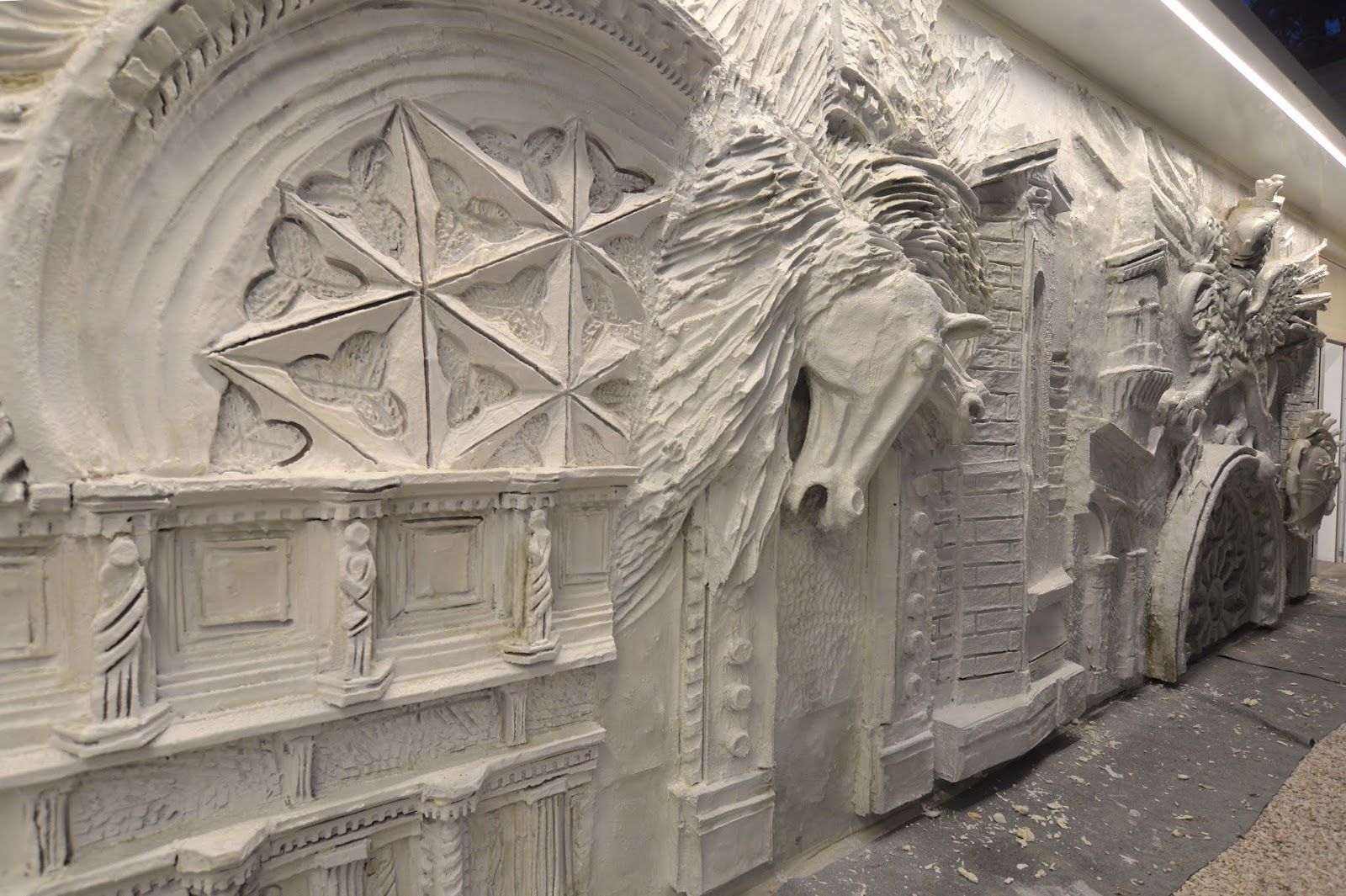

La consapevolezza della storia passata e dei valori culturali conferisce unità al grande bassorilievo della Posta dei Donini a San Martino in Campo. Vi sono i monumenti più significativi e belli della sua terra descritti come in un piano sequenza cinematografico, forme amate e sempre studiate come i rosoni che nella geometria perfetta fissano nella pietra valori trascendenti ed eterni.

Paolo Ballerani   Paolo Ballerani
 

Anche il bassorilievo per Mugnano racconta una storia antica, cara a quel paese ma anche al passato rurale dell'Umbria. Collocata presso l'arco dal quale passavano le raccoglitrici del tabacco, ne ripercorre il cammino e le fa tornare. Le grandi morbide foglie in primo piano lasciano emergere, come da un lago mosso e vitale, i visi dai lineamenti classici e forti, i fazzoletti semplici legati proteggere i capelli. Segue l'asino con la soma, animale oggi in via di estinzione, con il suo muso buono, gli occhi dolcissimi e il suo raglio sgraziato ma familiare nella campagna. In terzo piano il rosone romanico, perché i monasteri hanno costruito la civiltà medievale e il lavoro e il sudore hanno sempre avuto come sfondo la bellezza architettonica. Una ciminiera in lontananza presagisce il futuro che cambierà quella vita stagliandosi con sua rigida geometria. Meditazione sul tempo e sulla storia, sulla fatica e sulla bellezza del passato, la patina antica aggiunge poesia alla figurazione e la colloca in uno spazio che è della mente e del cuore.


Paolo Ballerani
Paolo Ballerani

Un gesto commovente lega il Cavaliere Stanco al suo cavallo. Si appoggia ad esso e china il suo capo coperto dall'elmo. L'armatura non nasconde la sua fragilità. La spada ha spaccato il rosone, i valori per cui ha combattuto sono infranti. Lo sostiene solo il cavallo, la fedeltà dell'amicizia senza parole, e una rosa che la mano porge racconta il desiderio di pace e d'amore. Qui i sentimenti improntano l'opera e l'emozione traspare da ogni dettaglio in una sintesi di pura poesia.


Paolo Ballerani


Paolo Ballerani

La fantasia di Paolo va a briglia sciolta come i suoi cavalli, prende il volo con la vastità della criniera che si dispiega nel vento, un vento metafisico e simbolico che fa pensare all'avventura, alla corsa verso la vita con lo slancio del coraggio e della ragione. La ragione, sì, perché la forma si espande nell'aria ma non si sgretola, non perde i connotati della realtà, realtà sognata e stilizzata, ma non negata e confusa. La sua scultura ha radici solide ed eleganti, colte e preziose, dalle quali dispiega le ali e lascia fluire linee melodiose, suscitando emozione e facendo vibrare di luce la materia.


Paolo Ballerani

Rita Castigli con un'opera di Paolo Ballerani

Paolo Ballerani

Paolo Ballerani

Paolo Ballerani

Paolo Ballerani

Paolo Ballerani

Paolo Ballerani
Paolo Ballerani
Paolo Ballerani

Paolo Ballerani

Bassorilievo in marmo di Gualtiero Ballerani
Rita Castigli con un'opera di Paolo Ballerani

Free Rein

Paolo Ballerani working artfully

To define a perfectly executed work it is said that it is done artfully. Paolo Ballerani grew up with his father, Gualtiero, who "artfully" has always made sculptures. It is with evident pride that Paolo speaks of the one who made him love and study art and sculpture and of whom he keeps works of great perfection and beauty. So alongside his highly appreciated and prestigious activity as creator of installations all over the world (and at the National Gallery of Umbria) he makes sculptures and bas-reliefs and entrusts them with the expression of his most important and profound thoughts. 

The horse has always been a favorite subject for him, a message of beauty in naturally elegant lines, which tend to move away from reality to venture towards bold abstractions. Manes in particular expand like fireworks or form volutes and play with space like angelic draperies in mannerist and baroque paintings. The result is an intense yearning for space and freedom, a positive message of inner energy that flows along dynamic lines that are soaring. They are intensified by light thanks to the lacquering and glazes that Paolo uses with effects ranging from bronze to alabaster to white marble and gold and silver. But in those manes combed by the wind you can also perceive the flow of time that leaves deep furrows and wounds and builds a new harmony full of meaning. 

He was never afraid of large sizes, heights and vast spaces. The large horse of the Rocca Paolina that rears up under the Sangallo vaults seems to rebel against that closure and the oppression it represented. The aspiration to freedom and light radiates from its golden surfaces as a symbol that sums up the history of the city of Perugia and its long servitude. 

The awareness of past history and cultural values gives unity to the large bas-relief of the Posta dei Donini in San Martino in Campo. There are the most significant and beautiful monuments of his homeland described as in a sequence shot, the forms that Paolo always loved and studied like the rose windows which in their perfect shape fix transcendent and eternal values into stone. 

The bas-relief for Mugnano also tells an ancient story, dear to that village but also to the rural past of Umbria. Placed near the arch through which the tobacco pickers passed, it traces the path and makes them return. The large soft leaves in the foreground let emerge, as from a rough and vital lake, their classic and strong features and the simple handkerchiefs tied to protect their hair. Follows a donkey, animal near extinction today, with its good face, the sweetest eyes and its graceless but familiar bray in the countryside. Behind it you see the Romanesque rose window, because the monasteries built medieval civilization while work and sweat have always had architectural beauty as a background. A chimney in the distance foreshadows the future that will change that life by standing with its rigid geometry. 
Meditation on time and history, on the fatigue and beauty of the past, the ancient patina adds poetry to the figuration and places it in a space that is of mind and heart. 

A moving gesture binds the Tired Knight to his horse. He leans against it and bends his head covered by an helmet. His armor does not hide his fragility. A sword broke the rose window, the values for which he fought are broken. Only his horse sustains him, the fidelity of friendship without words, and a rose that his hand holds out tells the desire for peace and love. Here feelings shape the sculpture and the emotion shines through every detail in a synthesis of pure poetry. 

Paolo's imagination goes as loose as his horses, takes flight with the vastness of manes that unfold in the wind, a metaphysical and symbolic wind that evokes adventure, racing towards life with the enthusiasm of courage and reason. Reason, yes, because the forms expand in the air but never crumble nor lose the connotations of reality, dreamed and stylized reality, but never denied and confused. His sculpture has solid and elegant roots, cultured and precious, from which it spreads its wings and lets melodious lines flow, arousing emotion and vibrating with light.

martedì 3 marzo 2020

Libertà e Destino

Opere recenti di Arnhild Kart

Arnhild Kart

Arnhild Kart è cresciuta a Düsseldorf, metropoli industriale sul Reno, i cui grattacieli hanno ispirato atmosfere e valori ritmici dei suoi lavori. La metropoli inumana e impersonale, assurta  da un secolo a metafora della condizione esistenziale, è stata protagonista di bellissime tele di Arnhild, con luci e baluginii che fanno pensare alle piogge metafisiche dell'inferno dantesco o alle città del più tetro futuro fantascientifico come in Blade Runner. E sono quadri di struggente bellezza nella loro drammaticità, come pure commoventi sono i personaggi che lei costruisce, fragili saltimbanchi isolati che si arrampicano verso un cielo troppo lontano, oltre i grattacieli.

Arnhild Kart

Arnhild Kart

Artista di grande rigore formale e tecnico (infatti per molti anni è stata titolare di una fabbrica di articoli di design creando oggetti d'arredo perfetti), ha dipinto prospettive rigorose e geometrie direi pierfrancescane, un paesaggio urbano razionale ma non equilibrato né sereno. 
Col tempo quei muri e strade si sono andati scarnificando. Chi va nella cappella di San Severo a Napoli e, dopo essersi estasiato per le meravigliose sculture di marmo bianco, scende nel sotterraneo, vede quello che è la struttura vascolare indurita di un essere umano che solo ad essa è ridotto. Similmente, nei recenti quadri di Arnhild, i grattacieli sono diventati scheletri luminosi, fatti di filamenti di led che si incrociano ortogonalmente. Avvertiamo il senso metafisico di quelle strutture che sono entrate in noi come strutture di pensiero, articolazioni del senso dell'esistere. 
Ci giunge così il messaggio di Arnhild come un canto di libertà, un richiamo alla ricerca del senso al di là degli schemi imposti.

Arnhild Kart

Continuando la sua ricerca che scava le radici del vivere nelle forme che il pensiero assume, Arnhild ha individuato nel DNA il simbolo in cui sintetizzare i processi che regolano e trasformano la realtà. Nelle nuove tele si percepisce qualcosa che sembra crescere, fluire autonomamente, filamenti che sembrano essere vivi e riprodursi. La fantasia e il pennello di Arnhild inseguono con timore ed emozione  quei percorsi, lungo canali misteriosi nei quali il pensiero e la realtà cercano di incontrarsi.

Nei due quadrati neri tutta la tela è coperta da filamenti che non lasciano spazi vuoti né possibilità di dialettica. Il plexiglass dipinto dall'interno crea l'illusione dello spazio in cui scorrono le linee.
Nelle altre due tele quadrate invece restano aree che sembrano però precariamente libere con i filamenti neri che si allargano implacabili nelle aree grigie.


Arnhild Kart e Rita Castigli

Le tele rettangolari bianche e nere sembrano percorse da segni accesi e intensi con richiami a doppie spirali che hanno un ritmo musicale, una struttura melodica a più voci che si intrecciano in un campo vuoto. Un senso di bellezza e di respiro ampio ne emana, una possibilità di libertà. Note di diverse altezze e durate, timbri gravi scuri o alti e chiari. Gialli e rossi accesi e neri profondi, i colori riscaldano di emozioni leggerezze tenui e asprezze tetre, rendendo alla vita le sue tante varianti, i sapori e i moti del cuore. I segni colorati si muovono come in canali il cui illusorio spessore è ottenuto anche qui dipingendo la striscia di plexiglass dal lato posteriore.

Arnhild Kart

Nelle altre tele rettangolari lo sviluppo tortuoso dei colori di diverse tinte evoca lo spazio dinamico sia del mondo interiore umano che dell'universo, evidenziati nella parte centrale del dipinto. Negli altri settori della tela si coglie, come fuori fuoco, la stessa struttura di intrecci, il passato o il futuro di una storia in corso di svolgimento della quale l'uomo non siamo certi che sia attore responsabile con i suoi desideri ed emozioni a guidarlo o se subisca, come il resto dell'universo, un destino fatto di leggi che non dipendono da lui.

Arnhild Kart

Arnhild Kart

 Arnhild Kart

Arnhild Kart

Arnhild Kart

Arnhild Kart

Valeria Guarducci


Valeria Guarducci, Arnhild Kart e Rita Castigli


 *   *   *
Freedom and Destiny

Recent works by Arnhild Kart


Arnhild Kart grew up in
Düsseldorf, an industrial metropolis on the Rhine, whose skyscrapers inspired the atmosphere and rhythmic values ​​of Arnhild's works. The inhuman and impersonal metropolis, risen for a century as a metaphor for the existential condition, has been the protagonist of beautiful paintings by Arnhild, with lights and glimmers that suggest the metaphysical rains of Dante's hell or the cities of the darkest future science fiction like in Blade Runner. And they are paintings of poignant beauty in their drama, as well as moving are the characters she builds, fragile isolated acrobats who climb to a sky too far beyond the skyscrapers.
Artist of great formal and technical rigor (in fact for many years she was the owner of a factory of design items creating perfect furnishings), she painted rigorous perspectives and geometries I would say pierfrancescane, a rational but unbalanced and unsettled urban landscape.


Over time, those walls and streets have been somehow defleshed. Whoever goes to the chapel of San Severo in Napoli and, after having become enraptured by the wonderful white marble sculptures, goes down to the basement, sees what is the hardened vascular structure of a human being who is only reduced to it. Similarly, in Arnhild's recent paintings, skyscrapers have become luminous skeletons, made of filaments of LEDs that cross orthogonally. We feel the metaphysical sense of those structures that have entered us as structures of thought, articulations of the sense of existence. Thus Arnhild's message reaches us as a song of freedom, a call to the search for meaning beyond the imposed patterns.

Continuing her research that digs the roots of living in the forms that thought takes, Arnhild has identified in the DNA the symbol in which to synthesize the processes that regulate and transform reality. In the new canvases we perceive something that seems to grow, flow autonomously, strands that seem to be alive and reproduce.
Arnhild's fantasy and brush pursue those paths with concern and emotion, along mysterious channels in which thought and reality try to meet.
The whole black square canvases are covered with filaments that leave no empty spaces or the possibility of dialectics. The plexiglass painted from the inside creates the illusion of a space in which the lines flow.
In the other two square canvases, however, areas remain that seem precariously free while the black filaments that invade relentlessly the gray areas.


The rectangular black and white canvases seem crossed by bright and intense signs with references to double spirals that have a musical rhythm, a melodic structure with several voices that intertwine in an empty field. A sense of beauty and wide breathing emanates from it, a possibility of freedom. Notes of different heights and durations, serious dark or high light tones. Bright yellows and reds and deep blacks, the colours warm up the patterns with emotions that have soft lightness and gloomy harshness, giving life its many variations, the flavors and motions of the heart. The coloured signs move as in channels whose illusory thickness is also obtained here by painting the plexiglass strip from the rear.
 

In the other rectangular canvases the tortuous development of the colours of different hues evokes the dynamic space of both the human inner world and the universe, highlighted in the central part of the painting. In the other areas of the canvas one catches the same weaving structure, as out of focus, the past or the future of a story in progress of which man is not sure if he is responsible actor with his desires and emotions to guide him or if, like the rest of the universe, he undergoes a fate made of laws that do not depend on him.

giovedì 9 gennaio 2020

La Materia dei Sogni

Le ceramiche bianche di Silvano D'Orsi


Siamo fatti anche noi della materia di cui sono fatti i sogni, e nello spazio e nel tempo d'un sogno è racchiusa la nostra breve vita.


Le parole di Shakespeare raccontano queste opere.
Le forme sono perfette e luminose nel bianco irreale che le proietta nell'immaginario. Quei pantaloni e giacche e cappotti sono tenuti in piedi da qualcosa che non è della realtà e dell'esperienza. Sono capi di vestiario quotidiani e attuali, eppure vengono da un altrove che è quello del sogno.  Sono fatti di quella materia perciò ci raccontano qualcosa di noi che non sappiamo, sentimenti nascosti in gesti ripetuti, fatti meccanicamente e senza coinvolgimento.


Ecco che ora quelle cose prendono vita e ci parlano un loro linguaggio fatto di grazia e di umiltà, ma anche del grande mistero dell'essere al mondo come cose o come persone, soggette al tempo e allo spazio, solide e fugaci come i sogni.
La stessa impressione danno il corpo femminile e la la testa del cavallo, forme di eleganza sinuosa, tutti  e due simboli di bellezza e perfezione. Qui però il candore smaltato li accomuna ai vestiti in una visione che sposa la preziosa lucidità e lo studio alla commozione, in creazioni pensose e astratte, sorridenti e malinconiche.


Il violino si piega a diventare un corpo femminile, la sua voce sarà un sospiro d'amore, toccarlo sarà far vibrare ogni fibra e perdersi nella sua armonia. 
La mano dalle dita delicate e affusolate sembra voler afferrare qualcosa o protendersi emergendo forse dall'acqua. Una richiesta silenziosa d'aiuto rimasta inascoltata tenta ancora di esprimere un bisogno sommesso e sembra fissarsi in un ramo di corallo bianco levigato e perfetto.


...Oh voi dal dolce nome ch'io non chiamo
perché voi non mi amate ed io non vi amo.


Voi, Signora, siete per me come un giardino chiuso,
siete per me come un giardino chiuso
dove nessuno è penetrato mai.
Di profondi invisibili rosai...
 

 Chi osa? Chi vi prende? Chi vi tiene?
Siete come una spada senza l'elsa
pura e lucente e non brandita mai..


Il vostro volto
non muta se la mia mano vi tocca.
La vostra mano è quella che non dona.
Nulla di voi, nulla di voi si dona.
Però, nulla io vi chiedo, nulla attendo
se bene, debolmente sorridendo 
come chi langue e pur non s’abbandona...

(Gabriele D'Annunzio, Poema Paradisiaco)


 Baby, take off your clothes...
Baby, take off your clothes...
You can leave your hat on...

(Joe Cocker)


La femminilità in sé è resa in forme pure e sintetiche che danno la suggestione di un archetipo primordiale radicato nelle profondità del tempo all'alba della vicenda umana.


Se due stelle dovessero essere posizionate l'una vicino all'altra
e nello stesso tempo essere abbastanza distanti dalle altre
per non essere influenzate dalla loro attrazione,
esse comporrebbero un sistema separato
tenuto unito dal legame della loro mutua attrazione...

(William Herschel)

  
 Nuda io ti vidi
oh bellezza della bellezza
e chiusi i miei occhi
per paura di svenire...
 
(Patrick Pearce)


Le fotografie delle opere sono di Tato Richieri

Le ceramiche bianche di Silvano D'Orsi sono visibili e acquistabili presso Elel Ceramic Art


*   *   *


A Matter of Dreams

Silvano D'Orsi's white sculptures


We are such stuff as dreams are made on, and our little life is rounded with a sleep.
Shakespeare's words tell these works.
The shapes are perfect and bright in the unreal white that projects them into imagination. Those pants and jackets and coats are held up by something that doesn't belong to reality and experience. They are daily and current clothing, yet they come from somewhere else, the land of dream. They are made of that stuff so they tell us something about us that we don't know, feelings hidden in repeated mechanical gestures.
Here now those things come to life and speak to us their language made of grace and humility, but also of the great mystery of being in the world as things or as people, subject to time and space, solid and fleeting like dreams.
The same impression is given by the female body and the horse's head, forms of sinuous elegance, both symbols of beauty and perfection. Here, however, the glazed whiteness unites them to the clothes in a vision where the precious lucidity and the study mix with emotion, in thoughtful and abstract creations, smiling and melancholic.

The violin bends to become a female body, his voice will be a sigh of love, touching it will make every fiber vibrate and get lost in its harmony.
The hand with delicate and tapered fingers seems to want to grab something or reach out perhaps emerging from the water. A silent request for help remained unheeded
still tries to express a subdued need and seems to be fixed in a smooth and perfect white coral branch.
   
... Oh you with that sweet name I never call
because you don't love me and I don't love you.

You, Lady, are like a closed garden for me,
you are like a closed garden for me
where no one has ever gone into.
Of deep invisible rosebushes ...

Who dares? Who gets you? Who keeps you?
You are like a sword without the hilt
pure and shiny and never wielded ..

Your face
does not change if my hand touches you.
Your hand is the one that does not give.
Nothing of you, nothing of you is given.
However, nothing I ask of you, nothing I await
although weakly smiling
like someone who languishes and does not abandon himself ...
(Gabriele D'Annunzio)

Femininity itself is rendered in pure and synthetic forms which give the suggestion of a primordial archetype rooted in the depths of time at the dawn of the human journey.

If two stars were to be positioned close to each other and at the same time be far enough away from the others not to be influenced by their attraction, they would make up a separate system held together by the bond of their mutual attraction ...  
(William Herschel)

Naked I saw thee,
O beauty of beauty!
And I blinded my eyes
For fear I should flinch
(Patrick Pearse)

Photographs by Tato Richieri
The white sculptures of Silvano D'Orsi are visible and purchasable at Elel Ceramic Art
 https://www.elelceramicart.it/